
Short answer
AI customer support for D2C brands means using AI agents to classify each message, pull live order and shipping data, draft a reply in your brand voice and send it automatically only when confidence is high. Done well, it resolves routine questions like order status in seconds on WhatsApp, Instagram, Facebook and email, while refunds, angry customers and unclear cases go to your team.
Key takeaways
- Most D2C support volume is a handful of repeat intents: where is my order, returns and exchanges, product questions, payment and COD issues.
- AI only works when it's grounded in live data: Shopify orders, Shiprocket tracking, Unicommerce inventory and your written policies.
- Use a confidence threshold: high-confidence drafts send automatically, everything else waits for a person.
- Keep one customer memory across channels so nobody has to repeat their order number on WhatsApp after emailing.
Customer support is where D2C brands either earn the second order or lose the customer. In India it is also unusually fragmented: the same customer may message on WhatsApp, comment on Instagram, send a Facebook DM and email, sometimes about the same order on the same day. This guide explains how AI changes that, what to automate first, and how to keep it safe.
What AI customer support actually does
"AI support" covers very different things, from a scripted FAQ bot to an agent that reads the order and writes a full reply. For a D2C brand, the useful version does six jobs:
- 1
Understand the message
Classify the intent (order status, return, product question, complaint, refund, promotional) and tag it.
- 2
Find the customer
Match the person across WhatsApp, Instagram, Facebook and email so history and the open issue come along.
- 3
Fetch live data
Pull the order, payment, AWB and tracking status from Shopify, Shiprocket and Unicommerce.
- 4
Apply your policies
Use your written return, exchange, shipping and COD policies, not the model's guesses.
- 5
Draft in your voice
Write a complete reply with the real data in it, in the tone you set for that intent.
- 6
Decide: send or hold
Send automatically above your confidence threshold; queue everything else for a person.
A chatbot that only answers "Track your order here: [link]" is not doing this. The customer still has to do the work, and many write again.
What D2C support volume looks like
In most D2C brands, a small number of intents make up most tickets. A typical mix (illustrative, varies by category):
| Intent | Share of tickets | Good candidate for automation? |
|---|---|---|
| Where is my order (WISMO) | 30–45% | Yes, with live tracking data |
| Returns and exchanges | 10–20% | Partly: policy answers yes, approvals with a person |
| Product questions (size, ingredients, usage) | 10–20% | Yes, from your product knowledge base |
| Payment, COD and refund status | 5–15% | Partly: status yes, refund decisions with a person |
| Complaints and damaged products | 5–10% | Draft only, send after review |
| Promotional and spam | 5–15% | Filter out automatically |
The big wins come from the first and third rows: questions where the answer already exists in your systems.
Channels: why one memory matters
Indian D2C customers don't stay on one channel. A customer who emailed yesterday about a delayed parcel might send a WhatsApp today. If your support tool treats those as two strangers, your team asks for the order number again, and the customer gets more frustrated.
| Channel | Typical use | What to get right |
|---|---|---|
| Order updates, quick questions, COD confirmation | Fast replies, order context, approved templates for outbound | |
| Pre-purchase questions, comments, DMs after ads | Product answers, tone, moving complex issues to DM | |
| DMs and comments, often older customers | Same as Instagram | |
| Detailed complaints, returns, B2B and invoices | Full context, attachments, longer replies |
Read more in WhatsApp customer support for D2C brands.
Keeping AI replies accurate and safe
The two biggest risks are wrong facts (the AI invents a delivery date) and wrong decisions (it promises a refund you wouldn't give). Both are solved by design, not by hoping the model behaves.
- Grounding: every factual sentence in a reply should come from live data or your knowledge base.
- [Confidence thresholds](/glossary/confidence-threshold): a score for how sure the agent is. Above your threshold it sends; below, it waits for review.
- Hard rules: refunds, cancellations after dispatch, legal complaints and angry customers always go to a person, whatever the score.
- Sentiment: detect frustration and soften tone, or escalate.
- Audit trail: see what was sent, why, and what data was used.
The metrics to track
| Metric | What it tells you | Target direction |
|---|---|---|
| First response time | How long customers wait for the first reply | Down to seconds for automated intents |
| Resolution time | Time to fully resolve | Down |
| Automation rate | Share of tickets resolved without a person | Up, intent by intent |
| Reopen rate | Customers who write again on the same issue | Down; a high rate means replies aren't answering |
| CSAT | Customer rating of the resolution | Up or stable as automation grows |
| Escalation rate | Share sent to humans | Stable; should catch the right cases |
How to roll it out in 30 days
- 1
Week 1: map intents
Export a month of tickets. Tag the top 10 intents and write down the correct answer and data source for each.
- 2
Week 2: connect data and policies
Connect Shopify, Shiprocket and Unicommerce. Write short, explicit policies for returns, exchanges, COD and delays.
- 3
Week 3: draft-only mode
AI drafts every reply; your team approves or edits. Track how often drafts are sent unchanged.
- 4
Week 4: auto-send the safe intents
Turn on automatic sending for WISMO and product questions above a high threshold. Keep refunds and complaints in review.
See the full playbook: how to automate customer support with AI.
Choosing software
There are three broad categories: global helpdesks (Zendesk, Freshdesk, Gorgias), WhatsApp-first platforms popular in India (Interakt, Wati, Bitespeed, Limechat), and ecommerce-native AI support like MarQet CX. Our buyer's guide to AI customer support software for D2C brands compares them on the criteria above.
How MarQet CX handles this
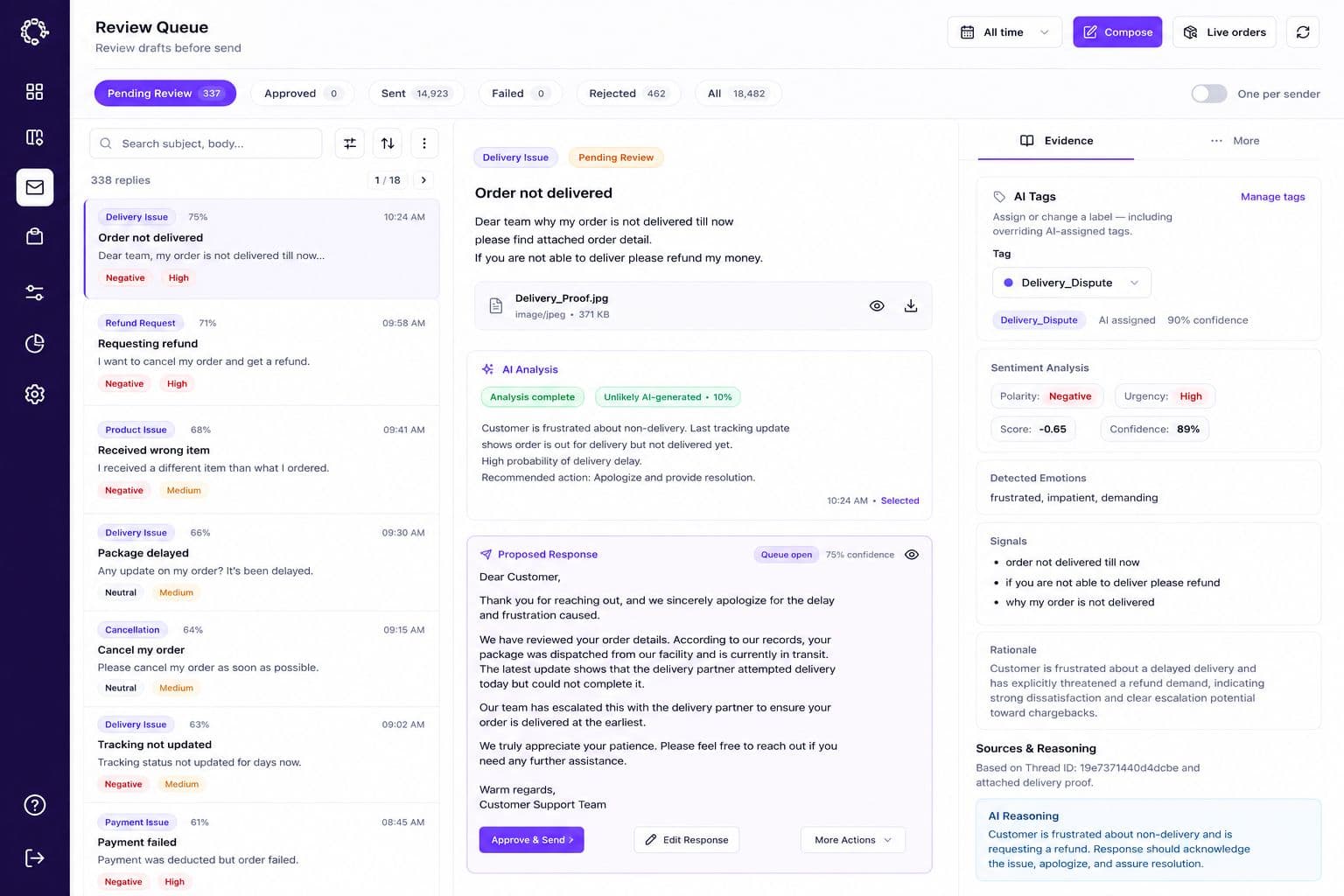
MarQet CX keeps WhatsApp, Instagram, Facebook and email in one customer memory, classifies each message, routes it to the agent you built for that intent, pulls live Shopify, Shiprocket and Unicommerce data, checks sentiment, and sends only what clears your threshold. Customers can rate each resolution with emoji, stars or a hosted form.
What "80% automated" actually means
Search queries like "how can a D2C brand automate 80% of customer support with AI" assume a single switch. In practice:
- Measure the mix first. If WISMO is 55% of tickets and you automate 80% of WISMO, you automated about 44% of the inbox — already a different week for the team.
- Product questions and policy questions are the next slice.
- Refunds, leaks, "delivered but not received" and angry threads stay human.
- The 80% target is a mix target, not a promise. Use the support cost calculator on your own volume.
Channel rules that keep AI safe
| Channel | Typical risk | Rule of thumb |
|---|---|---|
| Customers expect a fast, human tone | Auto-send only high-confidence WISMO; never ask for an order ID you already have | |
| Instagram / Facebook | Public comments and DMs mix | Keep complaints off auto-send; public replies should be short and move to DM |
| Longer threads, attachments | Fine for WISMO; watch refunds and legal language |
One customer memory across those channels is what stops "please share your order ID" on WhatsApp after they already emailed.
A worked cost example (illustrative)
4,000 tickets / month, 6 minutes each, 4 agents at ₹45,000 loaded cost. Using the same defaults as the calculator, most of the cost sits in WISMO. Automating 70% of a 55% WISMO mix is the first saving; it does not remove the people who handle the rest. Numbers are illustrative, not MarQet customer rates.
Frequently asked questions
Can AI handle customer support for a D2C brand?
Yes, for the repeat questions that make up most volume, such as order status, product questions and policy answers, as long as replies are grounded in live order data and a confidence threshold holds back uncertain replies.
Which support tickets should a D2C brand automate first?
Start with where-is-my-order questions and product questions. They are high volume, have clear answers in your systems and carry low risk. Keep refunds and complaints in human review.
Does AI support work on WhatsApp and Instagram?
Yes. Tools like MarQet CX answer on WhatsApp, Instagram, Facebook and email, and keep the same customer memory across those channels.
Will AI replace my support team?
No. It removes repetitive work so your team can focus on refunds, complaints, escalations and the conversations that build loyalty.
How do I stop AI from giving wrong answers?
Ground every reply in live data and written policies, set a confidence threshold for automatic sending, and add hard rules that always route refunds, cancellations and angry customers to a person.

Written by
Ayush Singhal, Founder, MarQetAyush founded MarQet to give D2C founders one system for customer conversations, daily performance and quick-commerce shelf availability.