
Short answer
D2C logistics automation software handles repetitive shipping work: allocating couriers, generating labels, sending tracking updates, acting on failed deliveries (NDR), verifying COD orders and analysing RTO. Indian brands typically combine a shipping aggregator such as Shiprocket, an OMS such as Unicommerce, WhatsApp automation for updates and confirmations, and a blended analytics layer to see delivery and RTO performance.
Key takeaways
- Automate the decisions that repeat hundreds of times a day: courier choice, labels, updates, NDR follow-ups.
- Allocation rules should use your own performance data by pincode, not just price.
- NDR action within hours is one of the cheapest RTO reductions available.
- You can't improve what you don't see. Delivery and RTO analytics by courier and region close the loop.
Logistics is where small manual tasks multiply. Choosing a courier, printing labels, updating customers, chasing failed deliveries: each takes a minute, and at 500 orders a day that's a full team. This guide covers what to automate and which kinds of software do it.
What to automate
| Task | Manual pain | What automation does |
|---|---|---|
| Courier allocation | Picking couriers by habit | Rules by pincode, weight, payment mode and past performance |
| Labels and manifests | Copy-paste, errors | Generated on order sync |
| Tracking updates | Customers ask "where is my order?" | Proactive WhatsApp, SMS or email at key events |
| COD verification | Fake or impulse orders shipped | Automatic WhatsApp or IVR confirmation before dispatch |
| NDR handling | Failed deliveries ignored until RTO | Instant customer contact and reattempt scheduling |
| Returns and exchanges | Email back-and-forth | Self-serve portal with rules |
| RTO and delivery analysis | Monthly spreadsheet, if at all | Daily dashboards by courier, state, SKU |
Software categories
| Category | What it covers | Examples |
|---|---|---|
| Shipping aggregator | Multi-courier access, allocation, labels, tracking, NDR | Shiprocket |
| OMS | Orders and inventory across channels and warehouses | Unicommerce |
| Checkout and RTO tools | COD risk scoring, address checks | Checkout and RTO-prevention providers |
| Messaging automation | WhatsApp updates and confirmations | WhatsApp Business Platform providers |
| Support automation | Answer delivery questions with live data | MarQet CX |
| Analytics | Delivery, NDR and RTO performance by segment | MarQet BI |
Courier allocation by data
NDR: the cheapest RTO fix
When a delivery attempt fails, the courier raises a non-delivery report (NDR). If nobody acts, the courier tries again or returns the shipment. Contacting the customer within hours (to confirm the address, a time or an alternate number) saves a large share of these.
- 1
Detect
Pull NDR events from the aggregator as they happen.
- 2
Contact
Message the customer on WhatsApp with the reason and two options.
- 3
Update
Push the customer's response back as a reattempt instruction.
- 4
Escalate
Call high-value orders that haven't responded within a few hours.
Closing the loop with analytics
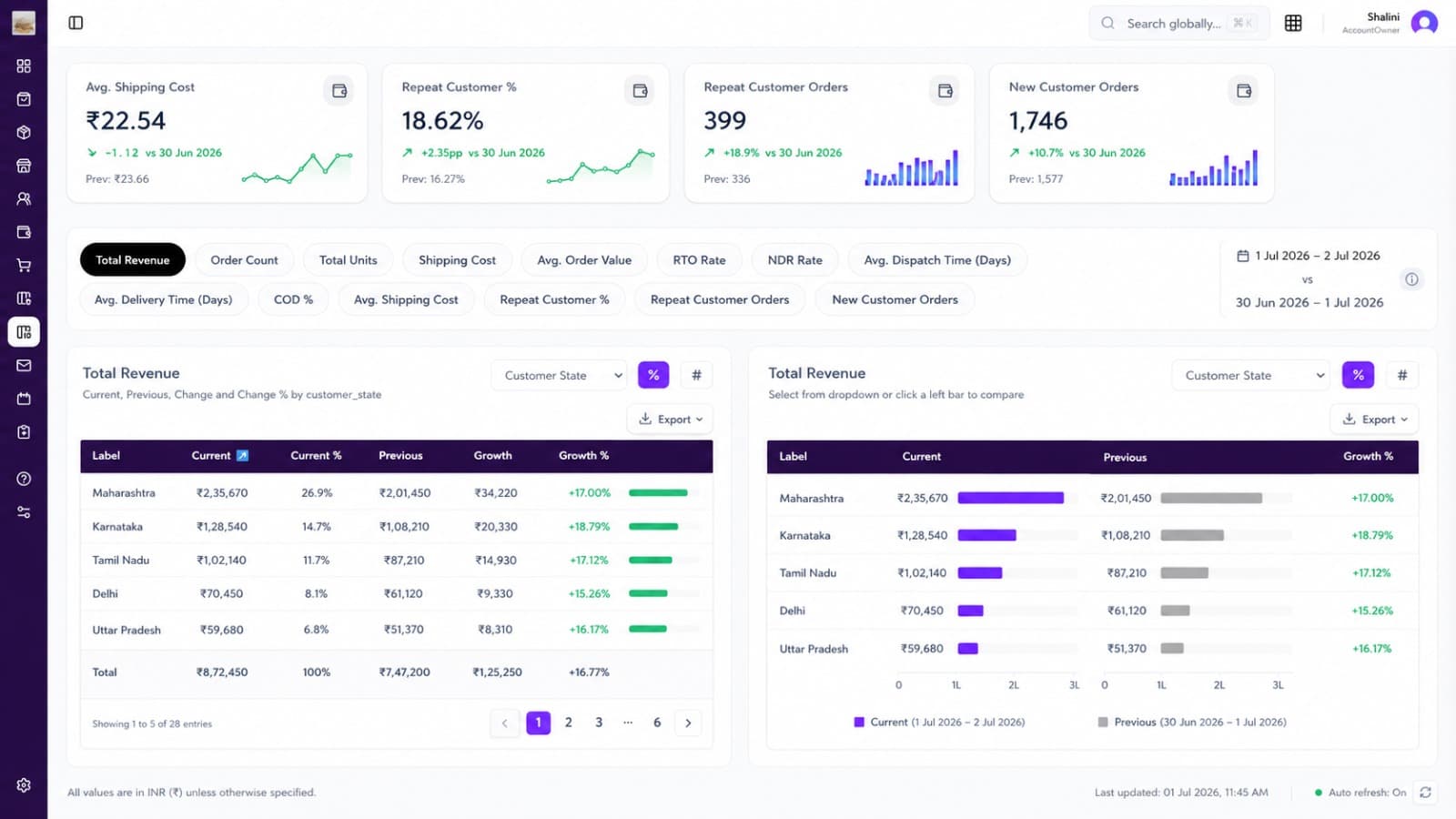
Automation without measurement drifts. Review weekly: delivery time and first-attempt success by courier and state, NDR rate and NDR-to-delivery conversion, RTO by payment mode, pincode cluster and SKU, and WISMO tickets per 100 orders.
How MarQet helps
Frequently asked questions
What is D2C logistics automation software?
Software that automates repetitive shipping tasks such as courier allocation, labels, tracking updates, COD verification, NDR handling and RTO analysis for direct-to-consumer brands.
Which logistics software do Indian D2C brands use?
Most use a shipping aggregator such as Shiprocket, an OMS such as Unicommerce as they add channels, WhatsApp automation for updates and COD confirmation, and an analytics layer for delivery and RTO performance.
How does automation reduce RTO?
By confirming COD orders before dispatch, contacting customers quickly after failed delivery attempts, and allocating couriers by their actual RTO performance per region.
Sources and further reading

Written by
Ayush Singhal, Founder, MarQetAyush founded MarQet to give D2C founders one system for customer conversations, daily performance and quick-commerce shelf availability.