
Short answer
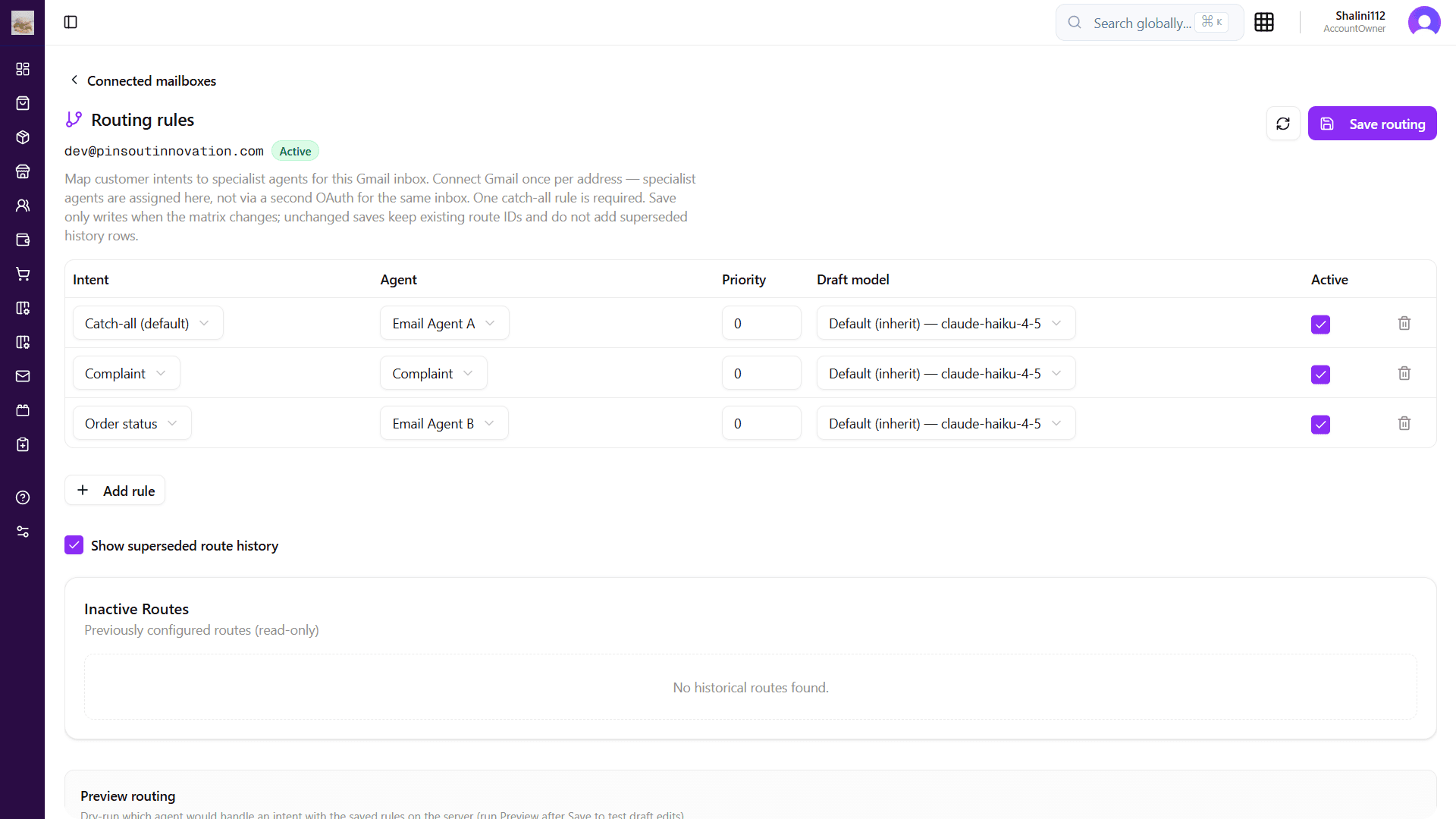
Agent orchestration in customer experience is the layer that decides which AI agent handles each customer message. Instead of one general bot, a brand runs specialised agents (order status, returns, complaints, product questions), each with its own instructions, tone, data access and sending rules. The orchestrator routes by intent and sends uncertain or sensitive cases to people.
Key takeaways
- Specialised agents give better answers than one general agent trying to be careful about everything.
- Each agent gets its own tone, rules, data and auto-send policy.
- The customer still experiences one conversation, because memory is shared across agents.
- Start with 3–5 agents covering your top intents.
As AI support matures, brands are moving from one chatbot to a team of specialised agents. Agent orchestration is what makes that team work together.
The problem with one general agent
A single AI agent handling everything must balance competing goals. It needs to be brief for order status, empathetic for complaints, strict about refund policy and enthusiastic about product questions. In practice it becomes cautious and generic everywhere.
How orchestration works
- 1
Classify
Each message is classified by intent: order status, return, refund, complaint, product question, promotional or other.
- 2
Route
The orchestrator sends it to the agent built for that intent.
- 3
Act
That agent uses its own instructions, tone and data sources to draft a reply.
- 4
Decide
The agent's sending rule (auto-send above threshold, or always review) decides what happens next.
- 5
Remember
The outcome is stored in shared customer memory so the next message, on any channel, continues the conversation.
Designing your agents
| Agent | Tone | Data | Sending rule |
|---|---|---|---|
| Order status | Brief, factual | Shopify, Shiprocket, Unicommerce | Auto-send above threshold |
| Product expert | Warm, specific | Product knowledge base | Auto-send above threshold |
| Returns and exchanges | Clear, policy-led | Order data, return policy | Explain automatically; approvals with a person |
| Complaints | Empathetic | Order, history, sentiment | Always review |
| Refunds | Careful | Payment status, policy | Always review |
Why it matters for D2C brands
D2C support isn't one workflow. A refund request has different rules from a delivery delay, and a damaged product needs a different tone from a size question. Orchestration lets you automate the safe workflows aggressively while keeping the sensitive ones human, instead of choosing one level of caution for everything.
Common mistakes
- Too many agents too soon. Start with your top 3–5 intents.
- Overlapping intents. If "exchange" and "return" agents both claim a message, define a clear rule.
- No fallback. Messages that don't fit any intent should go to a person, not the nearest agent.
How MarQet CX does it
MarQet CX classifies and tags every message, routes it to the agent you built for that intent, gathers knowledge base, history and live order data, checks sentiment, and applies your confidence threshold, across WhatsApp, Instagram, Facebook and email.
Frequently asked questions
What is agent orchestration?
The process of routing each customer message to the most suitable specialised AI agent based on intent, and managing how those agents share memory and hand off to people.
Why use multiple AI agents instead of one?
Specialised agents can each have the right tone, rules and data for their job, giving more accurate and appropriate replies than one general agent.
How many agents does a D2C brand need?
Start with 3–5 covering your highest-volume intents, typically order status, product questions, returns, complaints and refunds, and add more only when a clear need appears.

Written by
Ayush Singhal, Founder, MarQetAyush founded MarQet to give D2C founders one system for customer conversations, daily performance and quick-commerce shelf availability.